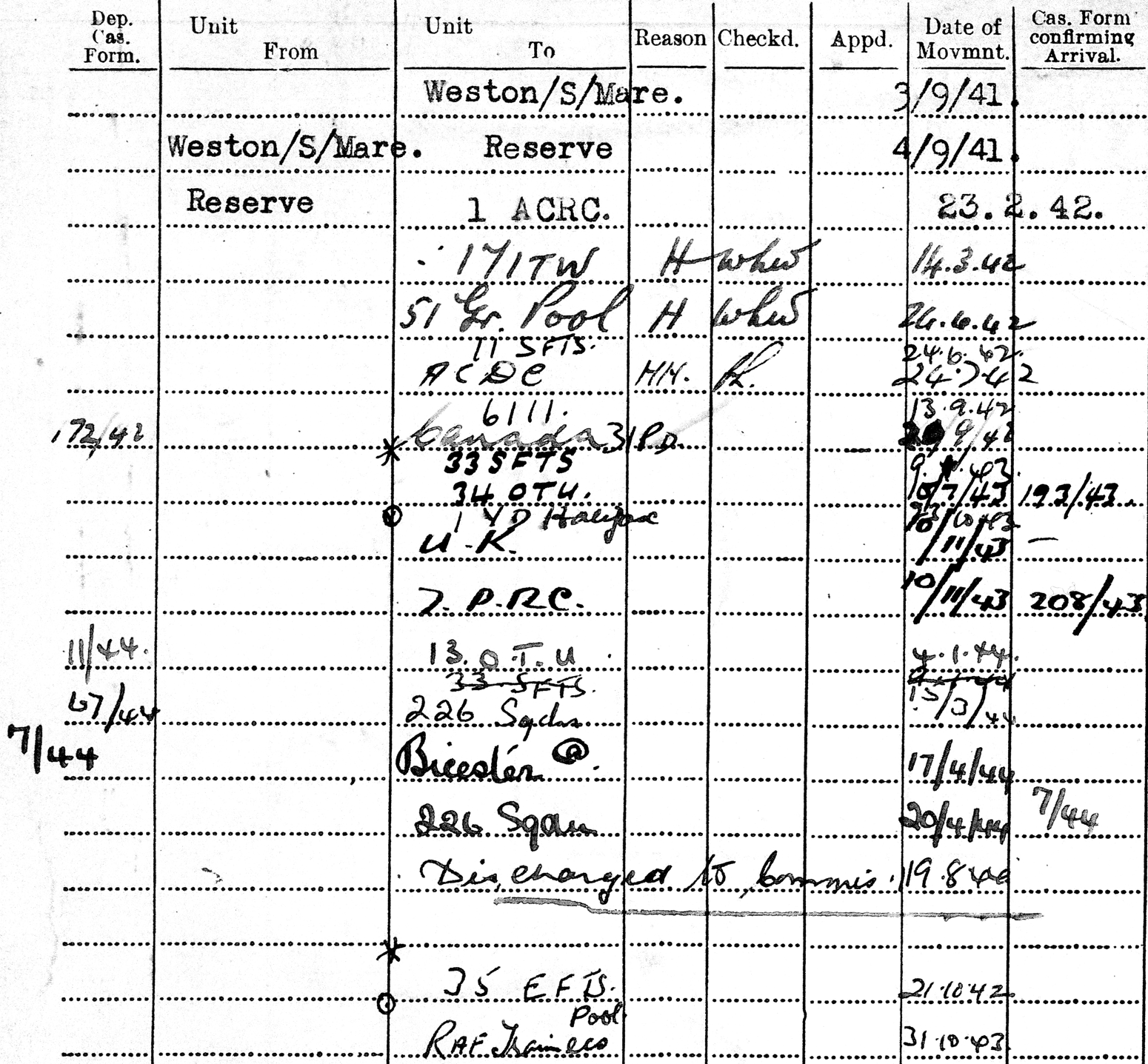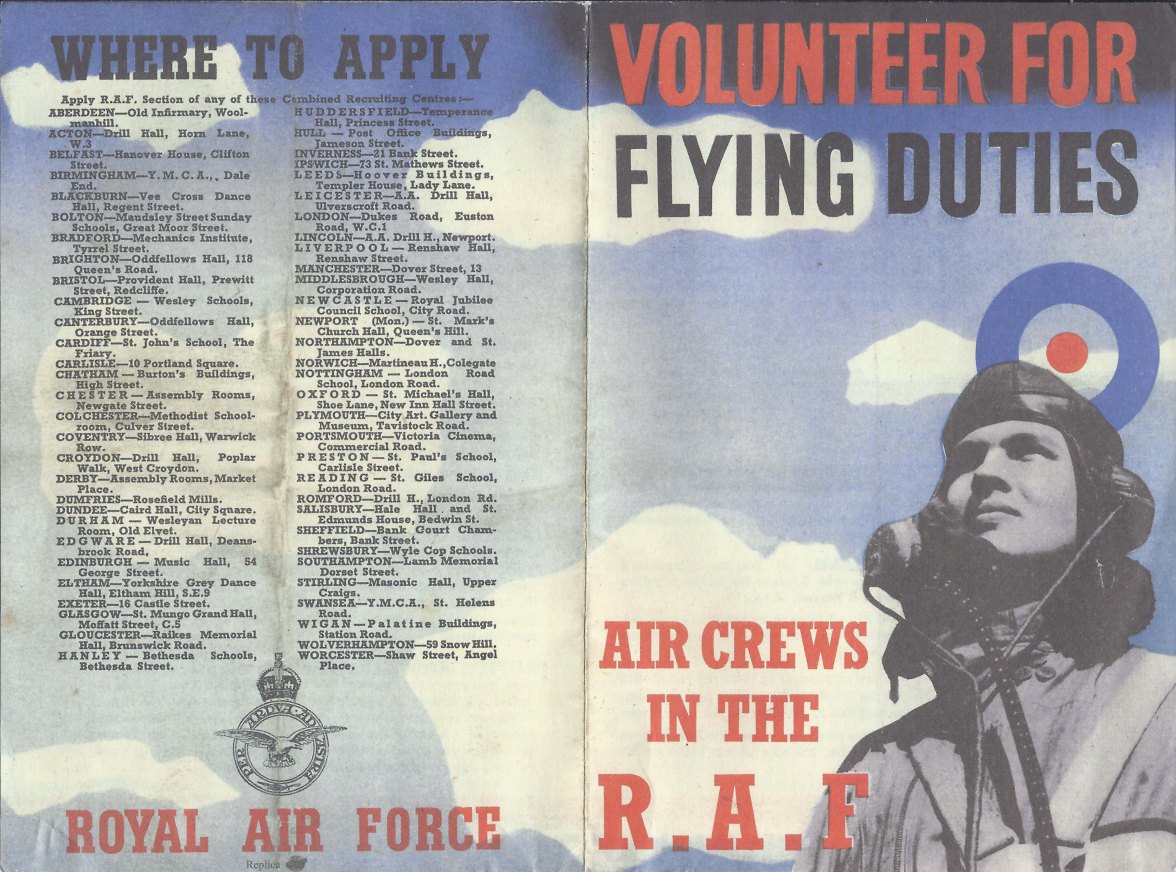
Having applied for his service record from the MOD it was brief to say the least, a slightly bewildering list of numbers and abbreviations but like many after volunteering he was dispatched to Canada for flight training as part of the British Commonwealth Air Training Plan (BCATP). The scale (and cost) of the training plan was staggering.
On return to the UK the conversion to Mitchell’s preceded being posted to 226 squadron, 2nd Tactical Air Foirce
4/9/1941 Weston-super-mare RAFVR
23/2/1942 1 ACRC, Air Crew Reception Centre
171 Training wing
51 GR POOL
No 51 Group was part of Flying Training Command and responsible for various Elementary Flying Training School’s. Disbanded 14.7.45.
24/6/1942 11 SFTS, RAF Shawbury
24/7/1942 – ACDC, Air Crew Dispatch Centre
The British Commonwealth Air Training Plan (BCATP), Canada
“YELLOW WINGS”
20/9/1942 31 PD Moncton, New Brunswick, Canada
No. 31 Personel Depot was also a one of a kind, the main reception centre for all members of the RAF moving by ship to and from the United States and Canada. The main port of arrival became Halifax, Nova Scotia, or New York City, New York. Next stop a quick change from boat to troop train, and a new adventure in a huge country. At Moncton the RAF were split into groups of 50 or more and sent west to various Elementary Flying Training Schools. The average transcontinental train journey could take five days and four nights.
A total of 47,406 British airmen passed through Moncton to be trained in Canada. The greatest number of these British pilots received their wings in the three Prairie Provinces, where six schools were located in Alberta, seven in Saskatchewan and two in Manitoba.
There were 899 British killed in training in Canada and their graves are scattered across the country. They got no wings and no recognition
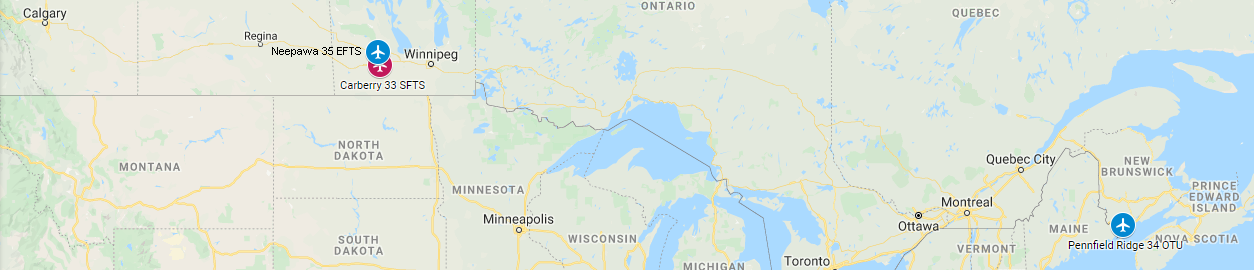
21/10/1942 35 Elementary Flying Training School
Formed at Neepawa (Canada) in March 1942. Unit disbanded in January 1944
“As I was walking through the gate an aircraft crash landed on the runway, not the best start”
Elementary Flying Training Schools gave a trainee 50 hours on a simple trainer, in preparation for WW II. Next step was the Service Flying Training School.
9/1/1943 33 Service Flying Training School
RCAF Station Carberry, Manitoba
“He must now adapt his flying to the handling of a Service type trainer, develop his skill and learn to use the aircraft for a purpose. At this School the pupil’s training as a potential officer or N.C.0. should be continued. No opportunity must be missed to give experience in the methods of controlling men as well as aircraft. The standard of drill, deportment and behaviour attained in previous schools must be maintained and the tuition in Service subjects completed.”
10/7/1943 34 OTU (Operational Training Unit) Pennfield Ridge, New Brunswick.
Pilots Course 16 12 July 1943
Trained as crews
Return to the UK
23/10/1943 1 YD HALIFAX (port)
10/11/1943 7 PRC (Personnel Reception Centre) Harrogate, UK – billeted in hotels e.g. The Majestic
4/1/1944 13 OTU, Operational Training Unit at Bicester – satellite at Finmere
Finmere airfield was built by the Air Ministry in 1941-42, it was commissioned by the RAF in July 1942 as a satellite to nearby RAF Bicester, which was an all-grass airfield and proved unserviceable during wet winter periods. No. 13 Operational Training Unit RAF moved to Finmere, bringing with them Bristol Blenheim Mk1 (short-nose) and Mk4 (long-nose) bombers. By the time of the arrival in 1943 of the similarly equipped No. 307 Ferry Training Unit RAF (FTU), formed at RAF Bicester in late 1942 to train pilots to ferry aircraft to northwest Africa, No. 13 OTU had moved onto the American A-20 Boston and North American B-25 Mitchell, much heavier aeroplanes with tricycle undercarriage. In early 1944 training increased on these types of aircraft for the Second Tactical Airforce (2nd TAF) part of joint operations for operation Overlord. Sadly there were a number of local crashes during training including one not far from the field at Gawcott, and another at Steeple Claydon, on both occasions the crew of four on each aircraft where sadly killed. The arrival of these aircraft meant that Finmere quickly eclipsed its parent station at Bicester in terms of operational importance, as they could not land at Bicester.