“Black clouds with hard centres”
In late 1944 the US armies battled to capture the bridgehead at Venlo and push the Germans across the Maas river. This operation was called Operation Aintree and it started with the US 7th Armored Division attacking the Overloon area on September 30th 1944
“137 wing had received a personal order from Basil Embry, C-in-C of 2 Group, 2nd TAF that, regardless of how many casualties we suffered, we were to destroy the Venlo bridge” (over which the Germans were retreating back to the Homeland).
Andy Cole Pilot 88 squadron
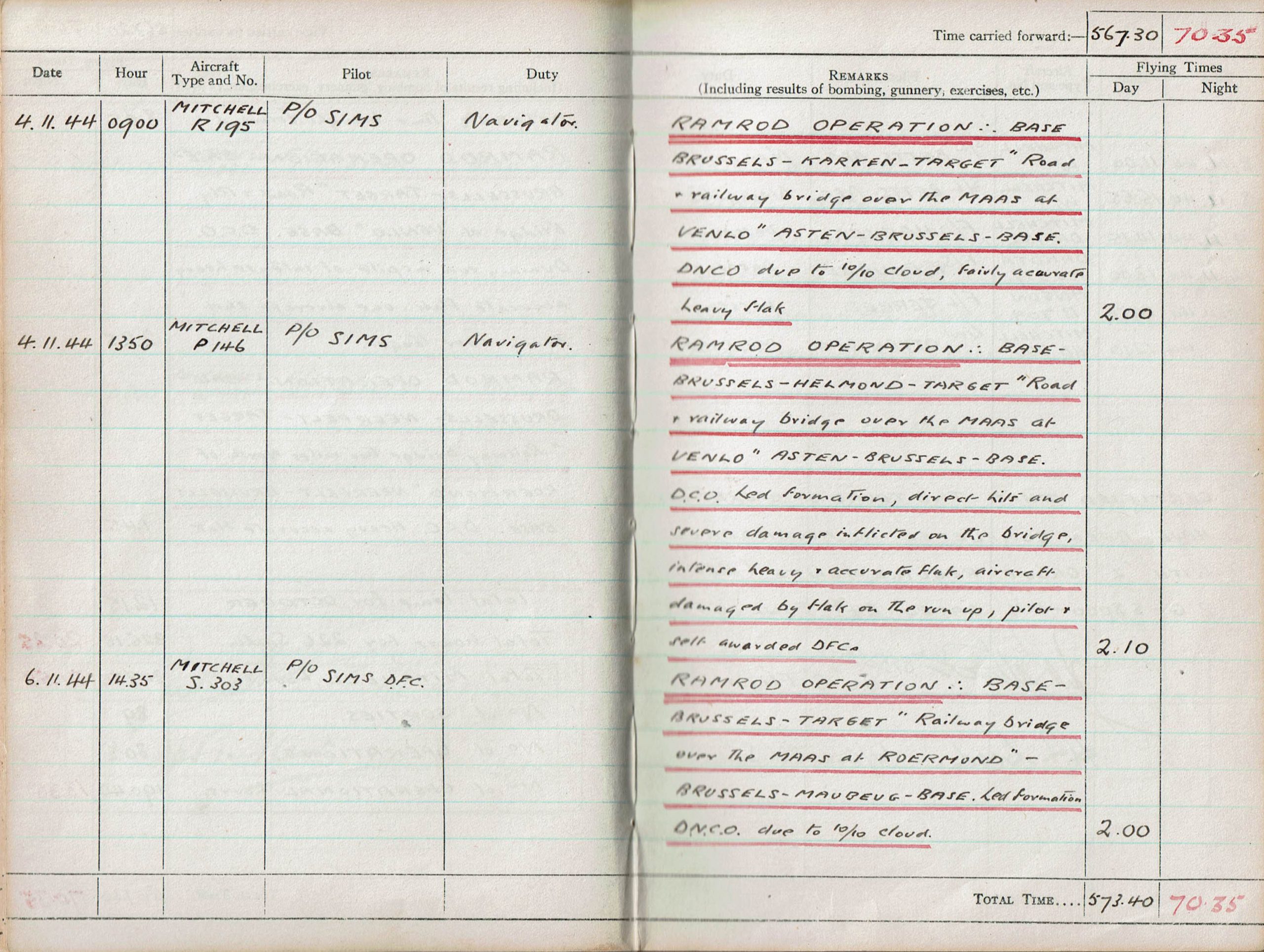
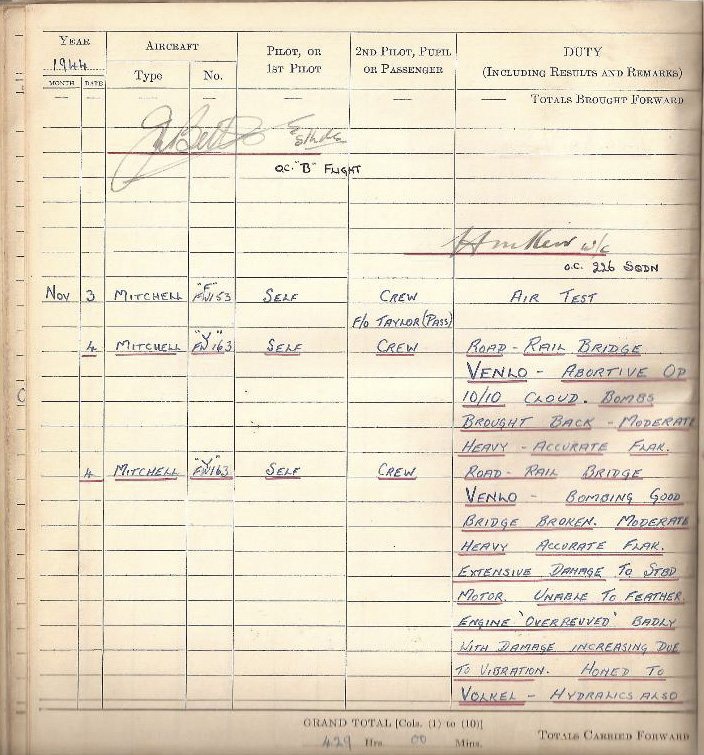
On 4th November 1944 12 Mitchells took off at 09.00 – target the heavily defended bridges at Venlo. They reached the target area but were unable to identify it through cloud
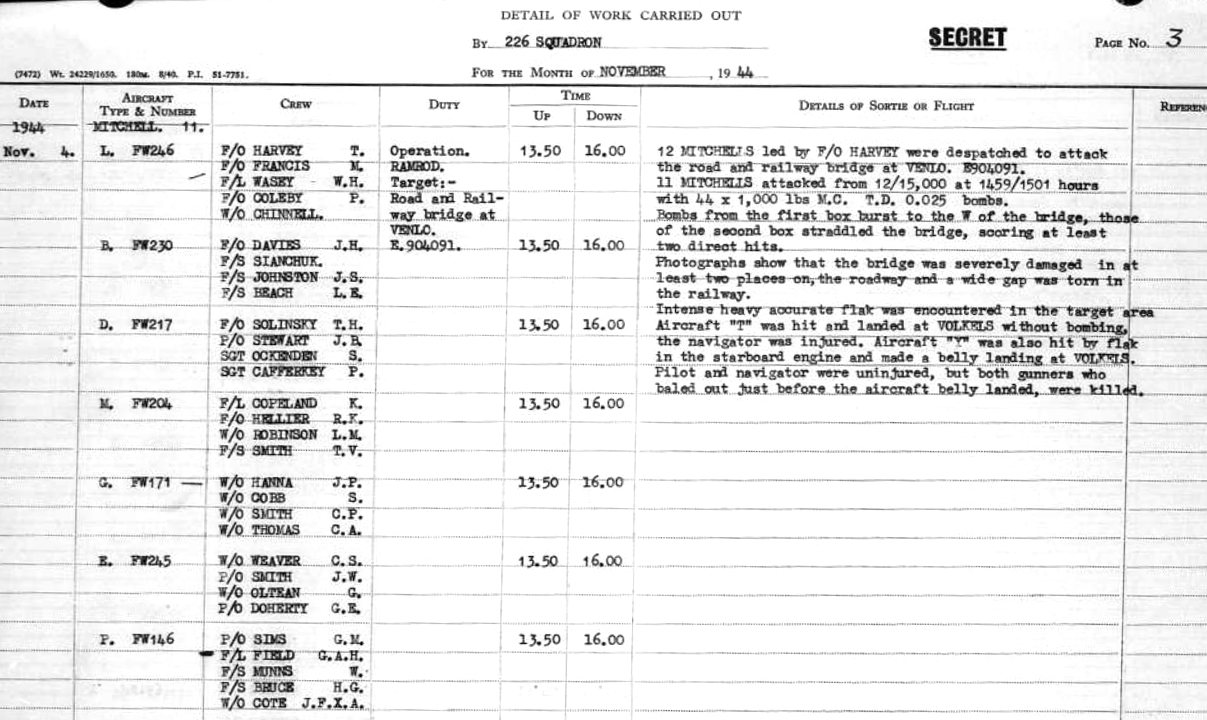
Later on the same day 12 Mitchells took off at 13.50 and attacked the same bridges at Venlo. The first box (a tight formation of six aircraft) missed.
P/O Sims leading the second box and dropping 1,000 lb bombs the bridge was hit.
The aircraft took 11 hits from flak, gunners would target the lead aircraft
He and his navigator were awarded the Distinguished Flying Cross.
Citation from the London Gazette, 15th December 1944
Bar to Distinguished Flying Cross.
Flight Lieutenant George Alexander Hughes FIELD, D.F.C.
(N.Z.4I6634), R.N.Z.A.F., 226 Sqn.
Distinguished Flying Cross.
Pilot Officer George Noel SIMS (185433), R.A.F.V.R., 226 Sqn
These officers were navigator and pilot respectively of the leading aircraft of a formation detailed to attack a road/rail bridge in the Venlo area: The target was vital to the enemy and was very heavily defended. In the run-in, intense and accurate anti-aircraft fire was encountered. The aircraft was hit. A piece of shrapnel tore through Flight Lieutenant Field’s compartment, narrowly missing him. In spite of this, he coolly and skillfully directed the run-in.
Displaying the greatest determination, Pilot Officer Sims maintained a steady course to make an excellent bombing run. The target was attacked with great precision and several hits were obtained. The success achieved reflects the greatest credit on the efforts of these officers who set a fine example, of skill, courage and devotion to duty.
7th November 1944 – Vitry en Artois
The A.O.C. was here today and presented P/O Sims with the DFC and a bar to F/L Fields DFC for pranging Venlo bridge on the 4th November
Damage Assessment
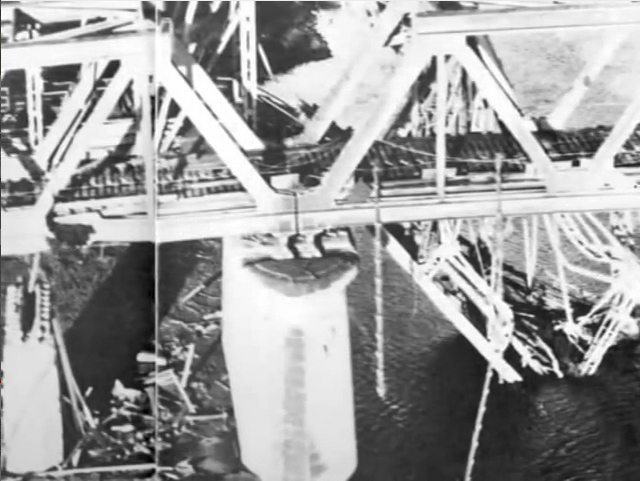
CONFIDENTIAL. 5th November 1944
2ND T.A.F. 2ND PHASE REPORT TAF/S.302
VENLO ROAD & RAIL BRIDGE (4416/Q1/E904091)
Photos taken at 1550A hrs.
COVER: Parts of the two NW. spans SHOWN on a single print. (Last cover 29th Oct. 1944, TAF/S.299)
DAMAGE: The second span of the road bridge from the NW. has collapsed and the girder work is hanging in the river. The damage to the rail bridge seen on 29th October is confirmed with possible new damage to the first span from the NW. The single track is probably temporarily impassable at this point.
CONFIDENTIAL DISTRIBUTION 100.
34 Wing Photo Intelligence
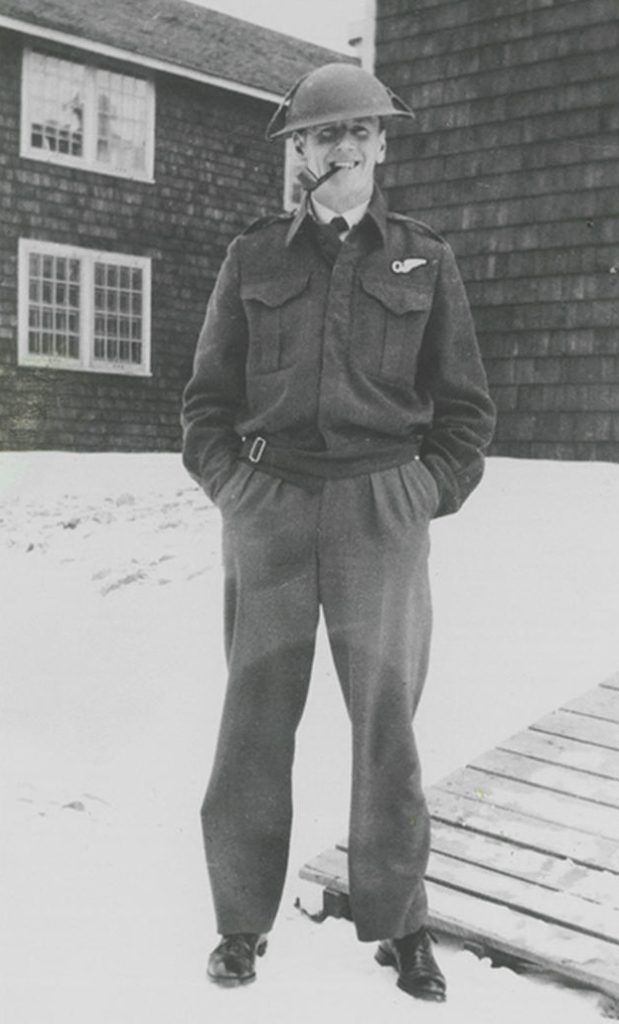
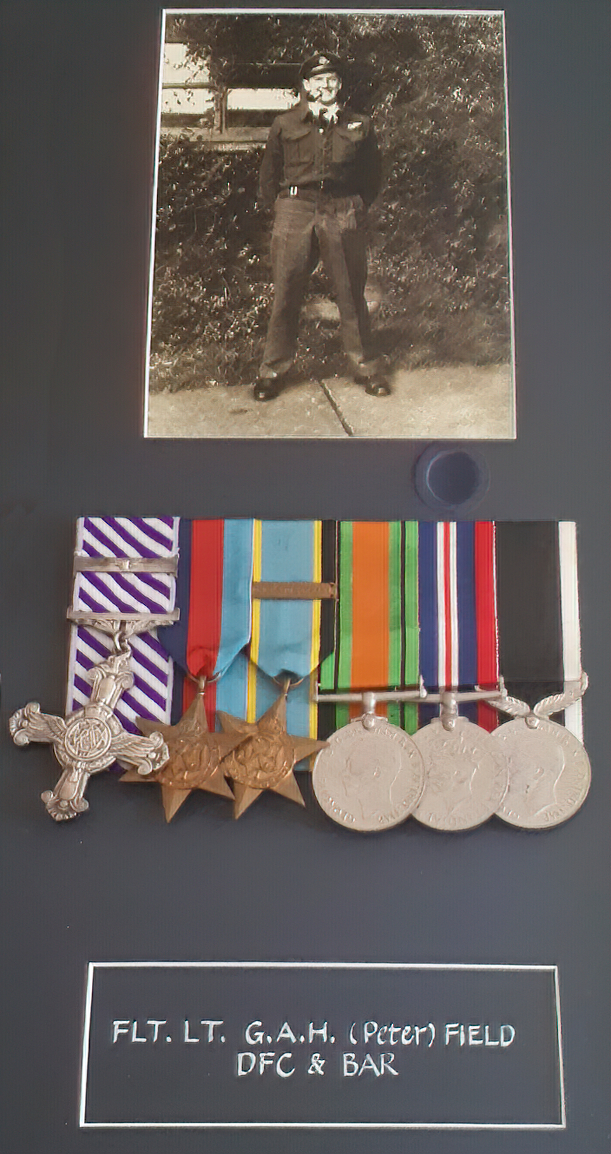
Flt. Lt. G A H “Peter” Field – Navigator
Born Wellington, 26 Nov 1905
RNZAF 416634 & 132088 30 Nov 1941 to 18 Jul 1945, Res. to 24 Aug 1958; Navigator/Bomb Aimer.
Citation Distinguished Flying Cross: Flight Lieutenant Field has displayed outstanding devotion to duty and great determination in air operations. He is a navigator of high merit and his excellent work has contributed materially to the success of the sorties in which he has participated. He has completed a large number of sorties, including attacks on airfields, communications, troop concentrations and other targets.
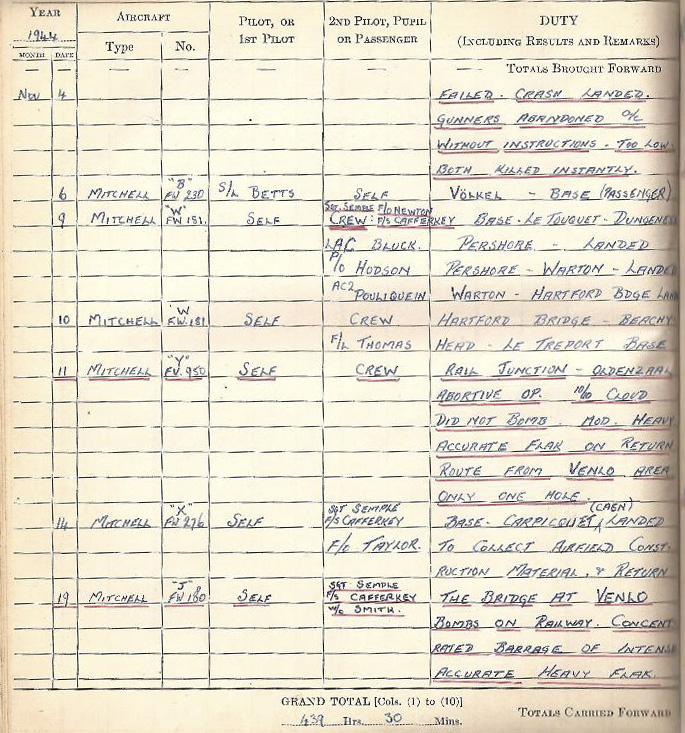
Between Sep 1943 and Nov 1944 Flt Lt Field completed two tours of 83 sorties, without a rest break. His flying log book is unusually detailed, listing not only target details but also recording the route from his base to and from his targets.
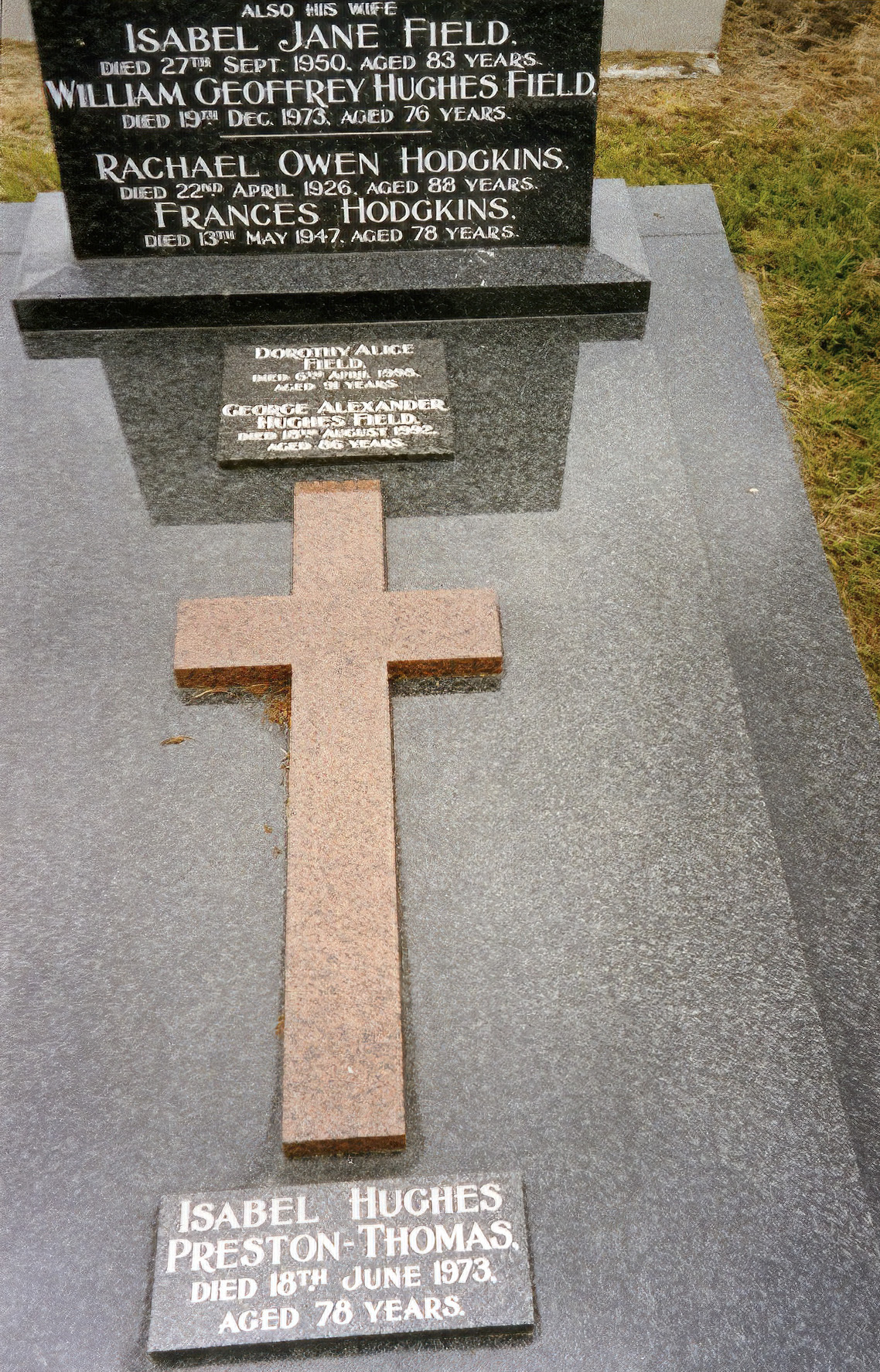
Died Waikanae, 18 Aug 1992.
I had tried to trace any surving family without success. Then one day a chance reply to an unrelated forum topic lead me to a gentleman from New Zealand, Terry Brown:
“Why my family has his medals is a convoluted story as we are not related to the Field family. In short when Peter died he was the last direct descendant of the Field family; my brother worked with him on the family farm and it all passed to him.”
Terry also told me that the son, Peter, had sadly died in a car crash
The tragic story of Sgt “Larry” Lorkin and his crew
Flying the same mission Sgt. Harry Lorkin , the pilot of aircraft Y, was able to provide some information, the following are his words:
“Our becoming involved in 226 Squadron was the result of a typical wartime muddle. In Canada we had been trained for Coastal Command. After graduating we were sent to Summerside in Prince Edward Island where our Navigator – Norman Semple – took an advanced navigation course and I became a ‘Pilot/Navigator’. From there to Debert in Nova Scotia where we learned to fly for hours over open water in Lockheed Hudsons; some of the later exercises were officially real anti-submarine patrols.
Meantime other groups like us were dicing around elsewhere in Nova Scotia flying Venturas in close formation at low level, being trained for Tactical Air Force (TAF). They finished up in Transport Command, and we forgot all about navigation over the ocean and were taught to fly Mitchells (B25s) in close formation.
No time was lost in getting us into an operational squadron because the fight to liberate Europe was well under way. Our task in 2nd Tactical Air Force was to use ‘pattern bombing’ – six aircraft in close formation all dropping our bombs simultaneously. Our targets were those which were intended to have immediate tactical benefit just ahead of the front line. Troop Concentrations were a favourite as – unfortunately – were bridges.
Bob joined our crew when we were posted to 226 Squadron. We all took to him immediately: Bob was a very easy guy to like. He joined us because although we had a full crew of four at the Operational Training Unit in Canada, one of our Canadian air gunners, being a married man, was excused from overseas duty.
Bridges were notoriously difficult to destroy. We certainly damaged them but they were such vital supply links that they were repaired virtually overnight. The road/rail bridge across the river Maas at Venlo was our worst nightmare. Bridges were very heavily defended by 88 millimetre anti-aircraft guns (Flak) which could fire more than 15 rounds per minute. Although Germany was not so advanced as us with radar, their optical gun-laying was superb.
By this time, the squadron had moved from its British base at Hartford Bridge to an airfield at Vitry-en-Artois in northern France. The airfield had little in the way of facilities; our billets were roughly-made wooden huts. However our crew was by now a really close-nit unit happy in its own company.
Our squadron, by the time we joined it, never had any close encounters with enemy aircraft. The Germans seemed content to leave it to their anti-aircraft guns which were only too effective. By that time the German Luftwaffe was a shadow of its former self and they seemed to be devoting all their remaining strength against the heavy bombers – Lancasters and Fortresses. There were occasions when fighters were put up against our attacks but happily for us they were always directed against other formations. Lack of fighter opposition was a blessing because our type of attack was always very vulnerable to enemy fighters.
We flew in tight formations of six aircraft, three in one “V” and three more close in behind them. This produced a ‘carpet’ of bomb-bursts. The leading aircraft had one gunner who was the ‘master gunner’ and his task in the event of an attack was to direct all the formations guns by radio so that – in theory – the incoming enemy would be met by a mass of bullets. So, Bob and Tom spent all their time over enemy territory searching the sky for signs of opposition. Venlo became a target for the first time on September 28th when we attacked it twice on the same day. On the second raid our aircraft’s hydraulic system was put out of action so that we had to use emergency methods for lowering the undercarriage and operating the brakes on landing.
On the 4th November 1944 we went to Venlo in the morning but brought our bombs back because heavy cloud obscured the target. This did not prevent encountering some uncomfortably accurate radar-directed anti-aircraft fire. We were briefed to return to Venlo in the afternoon when the cloud would have dispersed. Over the target the cloud had indeed cleared away so that we had a good view of the target and the ground gunners had a good view of us.
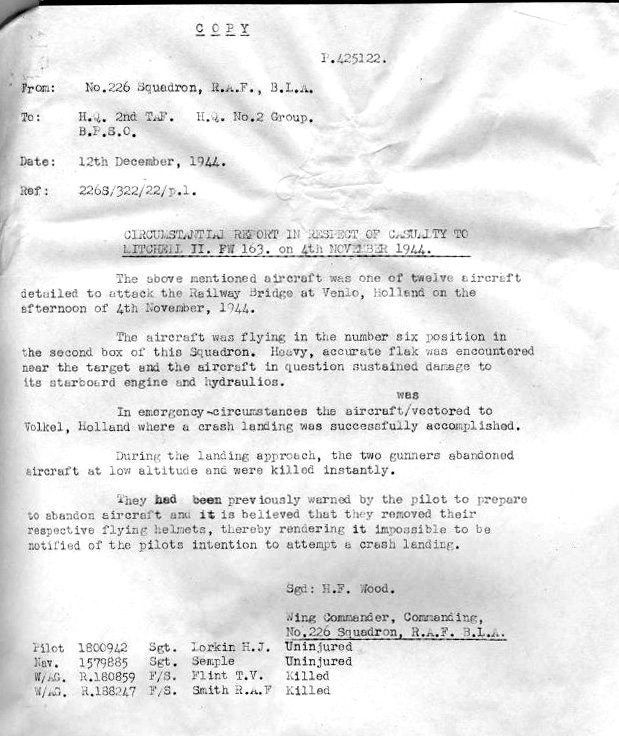
Just as we were leaving the target area, having dropped our bombs, we received a large piece of flak in the oil-cooler which caused us to lose all the oil in our starboard engine in just a few seconds. The oil, as well as lubricating the engine also operated the change of pitch of the airscrew. Normally when an engine is damaged the pilot ‘feathers’ the propeller, that is he turns the blades at right angles so that the movement through the air does not cause them to ‘windmill’. But with no oil in the system the blades of the airscrew turned itself into the ‘fully fine’ position which meant it ‘windmilled’ very fast indeed. With no oil for lubrication, the engine started tearing itself to pieces becoming white hot in the process. The noise it produced as almost unbearable.
At this stage I warned the crew to ‘stand by to jump’. This would mean that they should vacate the turrets, clip on their parachutes and jettison the lower door then await further instructions. A problem with the Mitchell was that there was no real physical contact between the air gunners at the rear and the pilot. There was a very narrow gap between the top of the bomb bay and the fuselage but we could not even see each other. Thus it was essential that we all kept plugged in to the inter-com until the last minute.
The navigator/bomb-aimer was rather better off having a tunnel over the nose-wheel compartment to move between his position in the nose and his seat alongside the pilot. Sadly, for some unaccountable reason, Bob and his colleague removed their helmets and so could not hear a voice from the ground telling us what course to steer to reach an airfield. Norman shouted “I can see it” and a few seconds later he pointed and said “There it is”. In those few seconds he had left his position in the nose compartment, negotiated the tunnel and sat himself next to me. The airfield was quite close so that we had to descend very steeply because we were going to get only one chance of landing.
The increase in speed caused by the steep descent caused the damaged engine noise to become even worse. In the rear compartment, with the floor hatch open and no ear protection from helmets, the noise must have been unbelievable. I selected ‘under-carriage down’ but only one leg emerged, so the hydraulics had also been damaged. Fortunately the only leg to lower was on the side of the good engine. Not that it made any difference, everything collapsed as soon as we touched the runway and the aircraft slid along on its belly causing such an array of sparking metal that I thought we would catch fire.
In the event everything went blissfully silent and I pushed Norman out through the roof escape hatch and followed him hastily. We stood there for a moment bathed in a feeling of sheer elation and the desire to find the owner of that saving voice to thank him. We walked to the rear intending to help the two lads out and our elation turned to puzzlement. Where were they? Two helmets there and parachutes gone. Before we had a chance to speculate I was approached by a senior officer who seemed more concerned with the fact that we had dropped a wreck on to his runway when a group of fighters were waiting to take off.
Meantime Norman was led away by another person. Little did I realise then that he was being taken to identify two bodies which had landed on the end of the runway; they had jumped too late for their ‘chutes to open. No one knows what prompted them to jump when we were so near to the ground. Perhaps the terrible noise prevented any logical thought. I have often agonised over whether I, as the pilot, should have been more insistent about parachute drill but at that age we were invulnerable, any problems would happen to the other guys.
The wartime air force had no time for sentiment. We had to wait a couple of days at that base which we learnt was Volkel, a former Luftwaffe airfield. On returning to Vitry, the C.O. made it plain that he would contact their families. We were sent on an two-day ‘errand’ to the UK and by the 11th November we were operating again with two new gunners and by the 19th we were back over Venlo when the flak was so accurate that our formation leader’s aircraft suffered a direct hit and exploded. I suppose that was the way in wartime. Rather like the way an unseated rider is urged to get back on a horse as soon as possible. No time was allowed for grieving
My sadness was compounded by the fact that Bob Smith had confided in me that he and an English girl had fallen deeply in love but I had no way of telling her what had happened. Bob never mentioned the girl’s name. It was something he mentioned after we had been moved from the UK to the airfield in France. He seemed to be worried as to how things would eventually work out but gave no details and did not want to talk about it afterwards.
I have never forgotten Bob, and as you see the memory is still vivid. Yes Bob was a very easy guy to like.”
F/Sgt. Smith and F/Sgt. Flint are buried next to each other at Groesbeek Canadian War Cemetery, Netherlands.
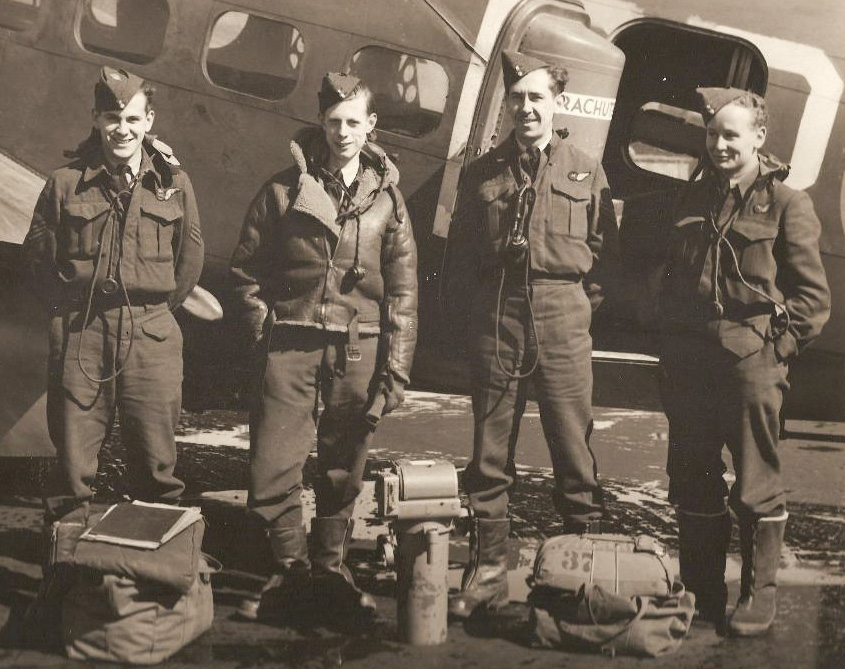
Flight Sergeant Robert “Bob” Alexander Smith, R/188247
Born May 31, 1924 the eldest son of Ernest Austin Smith, 1901-1983 and Florence Alexandra Smith (Picken) 1902-1978 at 212 Queen Street East in Hespeler, Ontario, Canada. Bob’s father’s family came from the county of Surrey, in the south-east end of England, his father was born there making Bob the first Smith in his line to be born in Canada.
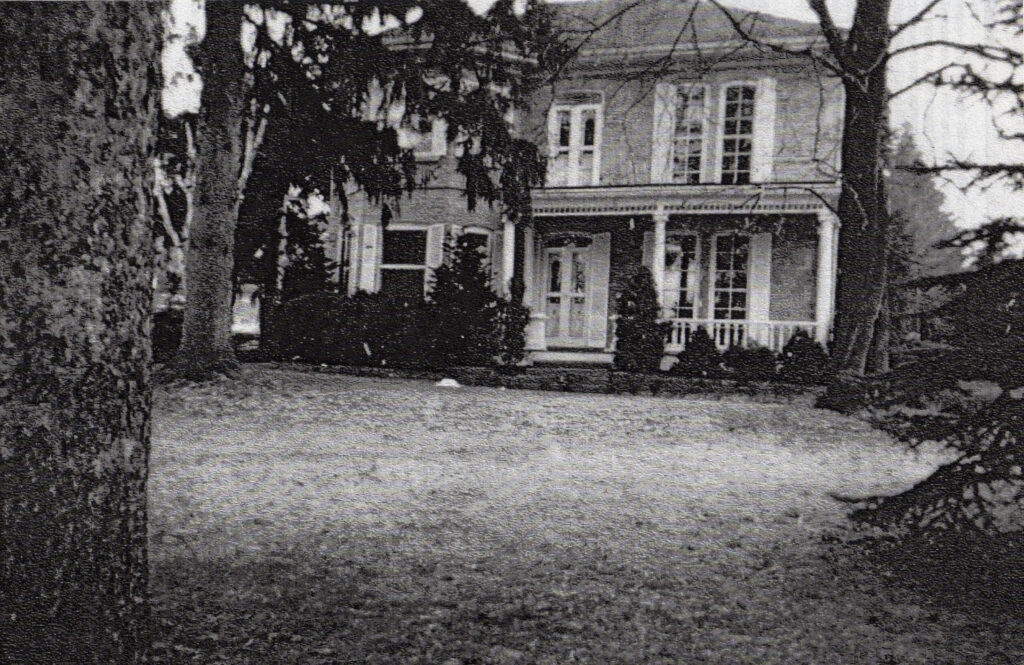
Bob joined the Royal Canadian Air Force in August of 1942. After almost 2 years of training in various locations in Ontario, Bob left Canada on May 25 , 1944 from Halifax, to arrive in the U.K. on June 2, 1944. Bob trained in the U.K. with 13 O.T.U. from July 18, 1944 until being sent to join 226 Squadron R.A.F. on August 8, 1944.
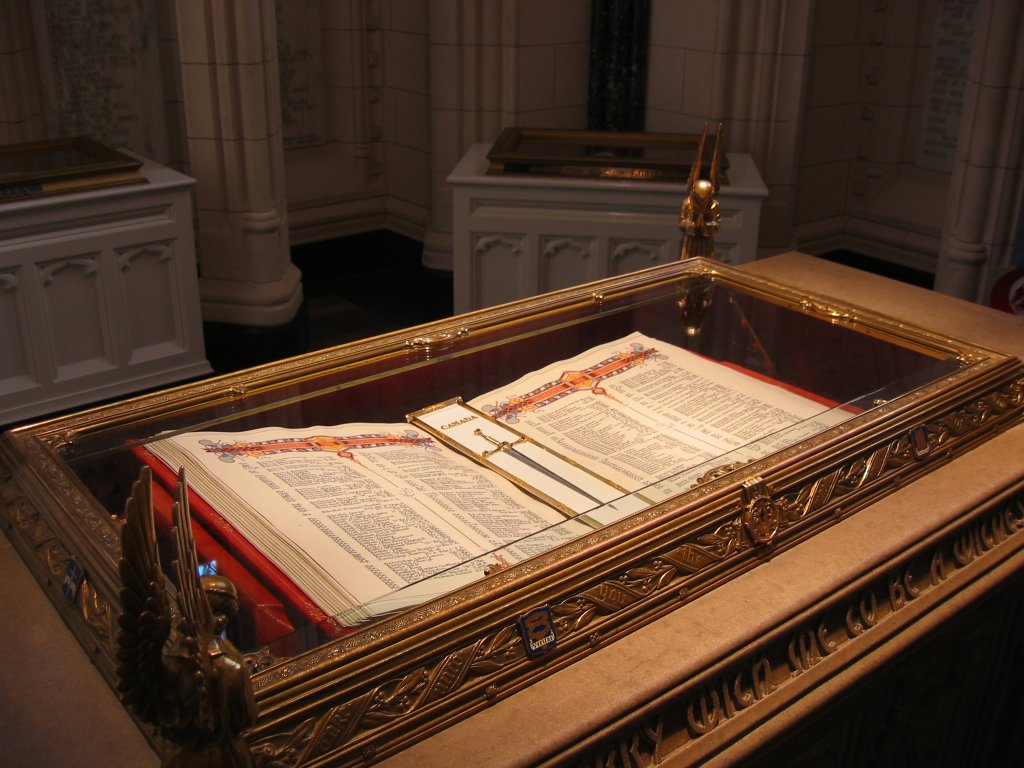
Robert is commemorated on Page 447 of the Second World War Book of Remembrance. The seven Books of Remembrance housed in the Peace Tower of the Canadian Parliament Buildings in Ottawa are illuminated manuscript volumes recording the names of members of the Canadian Forces and Canadian Merchant Navy killed on active service in wartime, and in other conflicts.
Flight Sergeant Thomas Vincent Flint, R/180859
Son of Thomas Henry and Albina Flint, of 123 Montreal Street,Kingston, Ontario
Commemorated on Page 306 of the Second World War Book of Remembrance
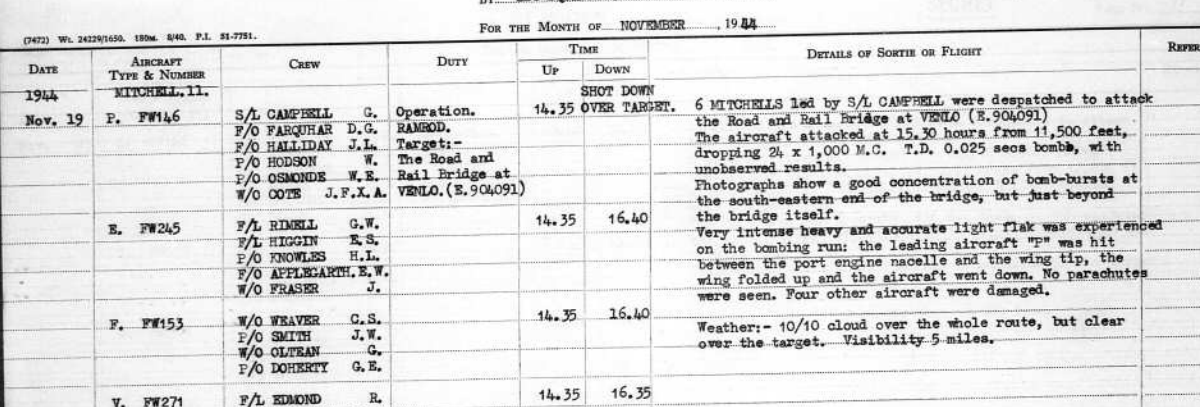
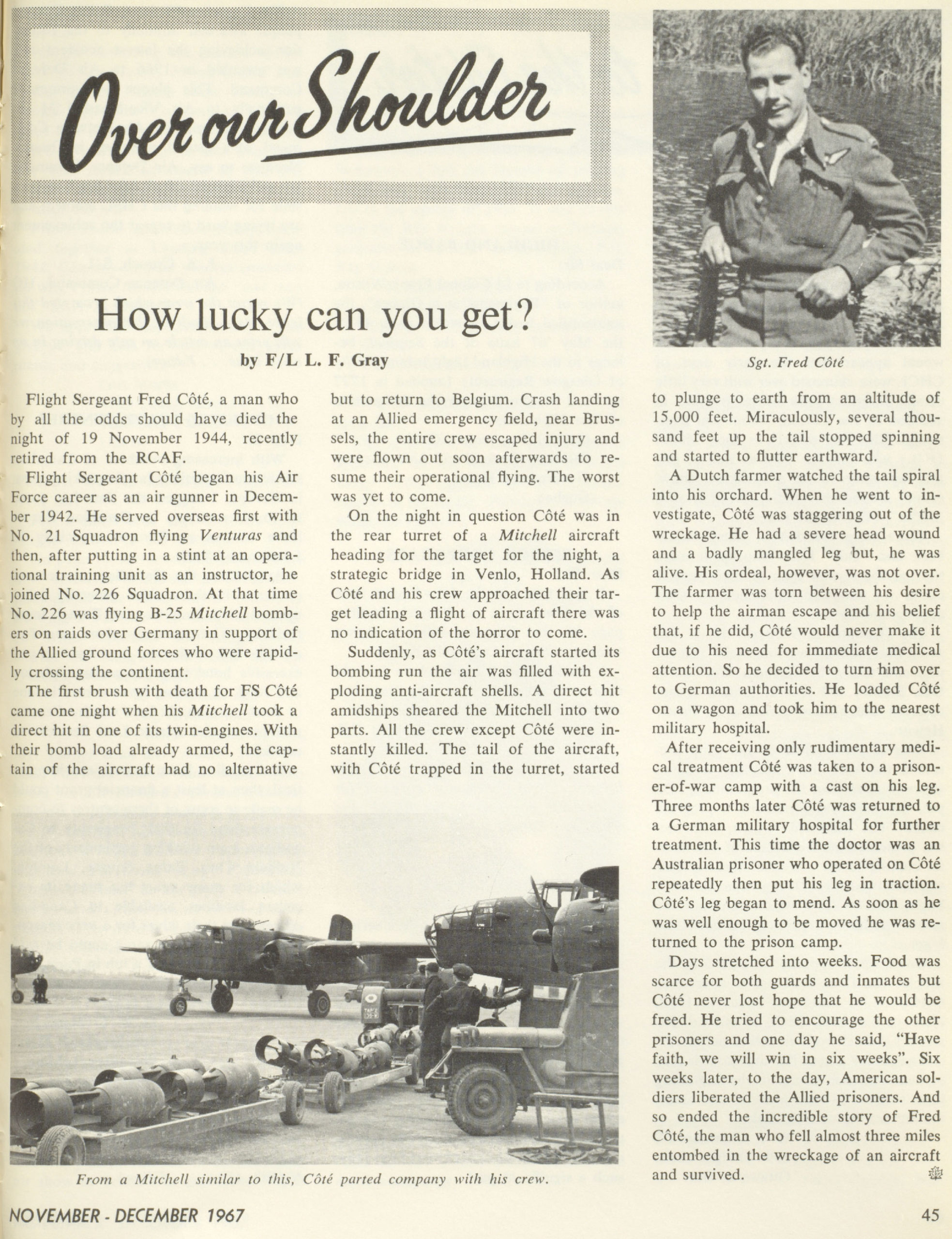
W/O J. F. X. A. “Fred” Coté RCAF, R82474 Air Gunner
Just 2 weeks later on 19th November 1944 WO Cote went back to the same target with a different crew, piloted by the Squadron Leader “Jock” Campbell. Immediately after bombing, the port wing was seen to receive a direct hit from flak just outboard of the engine. The aircraft broke away from the formation, turned upside down and was last seen going down in an uncontrollable dive from a height of about 6000 feet.
The rear portion of the tail, with turret and Cote, plunged several thousand feet before it ceased spinning and settled into a prolonged flutter, rather like a leaf.
A Dutch farmer watched the tail spiral into his orchard. When he went to investigate, Coté was staggering out of the wreckage. He had a severe head wound and a badly mangled leg but, he was alive. His ordeal, however, was not over.
The farmer was torn between his desire to help the airman escape and his belief that, if he did, Coté would never make it due to his need for immediate medical attention. So he decided to turn him over to German authorities. He loaded Coté on a wagon and took him to the nearest military hospital.
After receiving only rudimentary medical treatment Coté was taken to a prisoner-of-war camp with a cast on his leg. Three months later Coté was returned to a German military hospital for further treatment. This time the doctor was an Australian prisoner who operated on Coté repeatedly then put his leg in traction. Coté’s leg began to mend. As soon as he was well enough to be moved he was returned to the prison camp.
Days stretched into weeks. Food was scarce for both guards and inmates but Coté never lost hope that he would be freed. He tried to encourage the other prisoners and one day he said, “Have faith, we will win in six weeks”. Six weeks later, to the day, American sol-diers liberated the Allied prisoners, and so ended the incredible story of Fred Coté, the man who fell almost three miles entombed in the wreckage of an aircraft and survived.
The five crew members who didn’t survive are buried at the Jonkerbos war cemetery in Gelderland:
Pilot S/Ldr. Gilbert Campbell DFC & Bar 46638 RAF / grave 20 A 7
Navigator/Bomb Aimer F/O. D.G. Farquhar DFC 139615 RAF / grave 20 A 8-9
Special Operator F/O. J.L. Halliday 142460 RAF / grave 20 A 6
Wireless Operator/Air Gunner P/O. W. Hodson 185072 RAF / grave 20 A 8-9
Wireless Operator/Air Gunner P/O. W.E. Osmond 421929 RAAF / grave 20 A 5
Air Gunner W/O. Joseph Francois Xavier Alfred Cote R82474 RCAF / POW, wounded