
2TAF was formed on 1st Jun 1943
Britain’s 2TAF consisted of four RAF Groups: No. 2 Group, No.83 Group No. 84 Group, and No. 85 Group. Of these four, only the first three were really available for the air-land battle in Normandy; 85 Group was under the temporary operational control of No. 11 Group attached to an RAF home defense command.
No.2 Group consisted of four wings of Boston, Mitchell and Mosquito light and medium bombers.
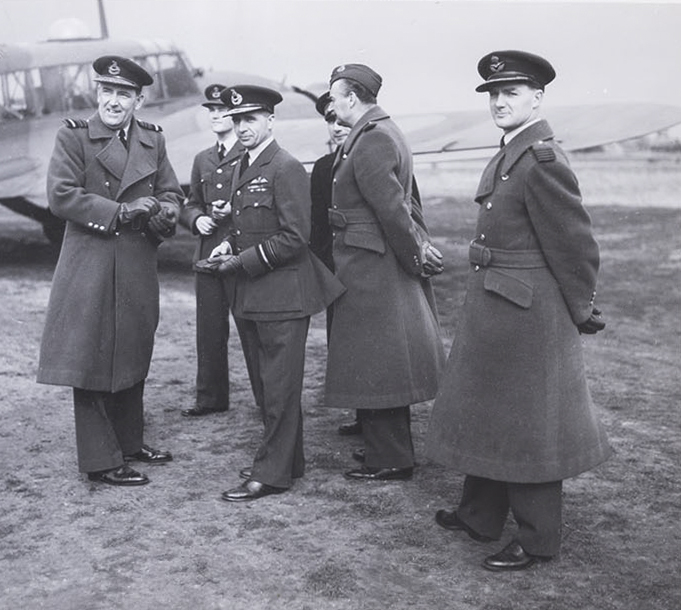
AVM Sir Basil Embry, AOC 2 Group
I took over command of No. 2 Group on the 27th May 1943, five days before it was transferred from Bomber Command to the 2nd Tactical Air Force, then forming as part of the build-up of British forces for Operation ‘“Overlord’’ The headquarters was housed in Bylaugh Hall, a large country house standing in its own park about seven miles from East Dereham in Norfolk, and domestic accommodation was in huts built in the woods surrounding the house.
Fighting strength of the Group consisted of three Boston, three Ventura, two Mitchell and two Mosquito squadrons, but the Mosquito squadrons were not transferred from Bomber Command with the rest of the Group, so on Ist June my new command was reduced to only eight squadrons, a very inadequate tactical bomber force for the task ahead of us. Almost more serious was the effect that multiplicity of aircraft types had on operational efficiency over past months. Four different types of aircraft in our small group of ten squadrons entailed many problems in the supply of spares and in technical administration. The operation of the force was made more difficult because all four types had widely varying flying characteristics, so that they had to be used as four entirely different units. Yet no single component was large enough by itself to inflict really telling damage on the type of targets which had been selected as bombing objectives for the Group.
The task of the operational training school supplying new crews to 2 Group squadrons was also made more difficult because multiplicity of aircraft types meant complexity in training. It was their responsibility to bring individual members of aircrew together and train them as a unified team. Each of the four types of aircraft in the Group had different sized crews, which ranged from five in the Mitchell to two in the Mosquito, so there was no interchangeability between types of aircraft once crews had been trained together and taught to operate the aircraft for which they had been selected. The school was having to train four different types of crew for ten squadrons, and the difficulties were reflected in the standard of the crews being trained, which in turn affected the squadrons.
Shortage of light and medium bombers was the reason for the Group’s variety of types. It was unavoidable, but the unfavourable impact it had on general efficiency was considerable. What struck me most forcibly on assuming command of 2 Group was the lack of clarity about its precise operational role. Over the past months a number of targets had been attacked in northern France, Belgium and Holland, but there seemed to be no over-all plan for the destruction of any particular class of target; the operations appeared to be a series of separate, uncoordinated attacks. I was left with the very definite impression that target selection had been of secondary importance to the desire to use day bombers as bait for German fighters during our fighter sweeps over France, the object of which was to bring the German fighter force to battle. Bomber Command was then fully preoccupied with its night offensive, primarily with four-engined heavy bombers, against German industrial centres, and the operation of the 2 Group light bombers was only a distraction from the main task and almost an embarrassment to the Command. Aircrew very soon realise when they are not playing a vital part in the operations of their Command and, like unwanted children, their morale and whole outlook on life suffers.
The Group had not recovered from the effects of its heavy casualties during the period when its Blenheims were used for low-level strikes on heavily defended ship targets. Although during that period the chance of survival of a member of aircrew was o°5 per cent higher than during the first Battle of France in 1940, the effects on aircrew were far greater because these high-intensity operations were continued for a much longer period, and sufficient attention was not given to evaluating whether the casualties suffered were worth the damage inflicted. There were certainly many occasions when ships had to be attacked at all costs, but crews should be made to feel that a highly dangerous operation will do heavy and useful damage to the enemy,as, for example, the sinking of supply ships in the Mediterranean definitely helped to defeat Rommel in the Western Desert and directly assisted our forces when locked in deadly combat with the enemy. But to have to carry out specially perilous missions as normal routine, day in and day out, without any positive object other than inflicting damage on enemy shipping was making a very heavy demand on aircrew, bearing in mind that the chance of surviving a full operational tour was very slender. Low-flying attacks on heavily defended ships by slow-flying aeroplanes employing the same tactics for months on end was unimaginative operational planning.
Lees had quite rightly put a stop to these operations as a matter of routine shortly after he assumed command in 1942, but they had left a deep impression on the Group and a feeling of scepticism in the minds of many of the aircrew. I also found that some were stale and in need of a change, not because they had flown a full operational tour but because their time in the squadrons had been unduly prolonged through in- activity caused by re-equipment. It would be unfair to suggest that the morale of the Group was at fault, because it was not, and indeed a Victoria Cross was won only a fortnight before I assumed command; but I was dissatisfied with the general approach to operational matters by the Group as a whole. A lack of urgency in the conduct of affairs was apparent, and there was not the same relentless and burning desire to damage the enemy, which was the spirit I had known in 107 Squadron and become accustomed to throughout Fighter Command. There did not seem to be a universally high sense of professional pride, a striving for perfection, which I expected to find. When some failed to hit their objective, their attitude was, ‘“Too bad,better luck next time’’, instead of feeling ashamed, investigating in detail why they had missed the target, and then asking to be allowed to repeat the operation.
My first impression was that I had taken over a tired and weary Group, but on reflection I came to the conclusion that the factors detracting from operational efficiency which I have already mentioned were answerable for the apparent apathy I found. No one from the Group or the various station headquarters was flying on operations, and therefore the only people in practical touch with current operational and tactical problems were the squadron aircrew. They began to believe that they all understood how operations should be conducted, and that the commanders and key staff officers belonged to a past age and did not understand their problems. This attitude of mind was comprehensible because there is no synthetic method of gaining operational experience, nor Divine Guidance when it comes to learning the details of operational flying, but it was a bad attitude as it hindered investigation into weaknesses and formed a barrier between squadrons and the staff. It was not a difficult problem to solve, however. It seemed to me that personal example in action at all levels of command and staff, and relentless insistence on the attainment of operational perfection, would quickly transform the efficiency of the Group.
One of my first actions after taking over command was to fly the Mitchell, Boston and Ventura so that I might assess their value as operational aircraft and try to understand from first-hand experience the operating problems of the crews. I came to the conclusion that both Mitchells and Bostons were excellent aircraft in every way, but that the Venturas were thoroughly bad, being slow, heavy, unmaneuverable and lacking in good defensive armament. I next called for an assessment of the average bombing error of the Group over the past nine months. I was told that to calculate this from the many photographs of bomb bursts would be a tremendous task, and did I really need it, because the bombing of the Group was excellent, as I could see by examining the photographs they held in the operations room.I replied that I was sure these photographs revealed some very good bombing, but I wanted to know what was the average error of all the other bombs not shown on the photographs on display.
I explained to Dart, our operational research scientist, exactly what I wanted and after about a fortnight of long hours of work, with some outside assistance, he assessed the bombing error of the Group. I did not retain the exact figure in my records, but memory recalls that it was something like twelve hundred yards. I was appalled but not disheartened! After visiting all the units in the group, meeting as many of the aircrew as possible, flying the operational aircraft, studying operational records and results, and knowing the bombing error, I now felt I had sufficient information on which to base a policy and prepare a plan to implement it.
Morale is the lynch-pin of efficiency and fighting spirit, so firstly I thought out what were to be the fundamentals of my policy to obtain the standard at which I aimed. I decided to issue a Clear statement on the immediate and future role of the Group, as I was convinced this would go a long way to clear up any doubts the aircrew might have had about the usefulness of their task, and give them a set purpose for trying to reach a higher standard of efficiency. By constant visits to units and talking to crews of the standard we must try to attain in the next few months, I tried to build up a real pride of achievement. I also increased the Group’s operational activities, as I believe there is no better way of building morale in war than by active operations which are carefully thought out and properly conducted.
Long periods of inactivity have the reverse effect, crews becoming bored and having too much time to think about the dangers lying ahead. Lastly, I issued an instruction that station commanders were to take part in active operations with their squadrons, though I made it clear that I did not expect them to lead their formations unless they felt they were sufficiently in practice to do so, and that I did not wish them to carry out more than two or three operations a month. At the same time I started flying on operations with the squadrons, and David Atcherley, who had joined me as my Senior Air Staff Officer, also flew as a passenger. At that time he was unable to fly himself as he had a badly fractured arm in plaster. Sometimes he and I flew together in a Mosquito on ground level attacks on targets, and I am certain it helped to build up morale throughout the Group.
As a tribute to his courage and high sense of duty, I would like to record that for over a year he flew on operations unable to use a parachute if need arose; and once when he slipped getting into my Mosquito and again broke his arm, which was still in plaster, he said nothing about it until our mission was over. Some might argue that it was a sign of a lack of balance on his part to fly and on mine to allow him to do so, but they did not witness the morale and spirit of 2 Group at that time. His example was an inspiration to us all. I personally thought it only prudent to hide my identity, as the Germans had circulated a description of me and put a substantial price on my head after my escape from France in 1940; so I became Wing Commander Smith, with the number of a genuine Smith of that rank, whenever I flew on operations. I had identification discs made and marked all the clothes in which I flew with his name, arranging so that my rank badges could be changed at will. Although these elementary precautions would probably not have borne over much investigation, I hoped they would give me the time I needed to make my escape break should I be unlucky enough to fall into enemy hands again.
Neither of us confined our activities to Mosquito operations but we also flew in the Mitchells, and David in particular flew as a passenger on many missions in these aircraft, observing and thinking out how efficiency might be improved. I am sure that by these methods we were able to bring up-to-date practical experience to bear on all our decisions affecting operational planning, training, policy and many other important matters. We were also able to watch the development of tactics and relate them directly to planning and the method of employment to four squadrons, and I feel convinced that this had a direct influence on improving the operational effectiveness of my Group and reducing our casualties. It is clear that if those who plan and control operations also take part in them, then no man is asked to do what his commander is not prepared to do himself, and surely that should be the basis of operational planning and leadership at the Group level of responsibility. In addition to Atcherley and myself; a number of the Group Staff officers flew regularly on operations either as pilot or passenger, and it helped them a great deal to understand operational problems which were the daily worries of the squadrons.
I also encouraged officers from the various Wing Headquarters to carry out a limited amount of operational flying, and these included chaplains, doctors, engineer officers, intelligence and operations-room officers. One army liaison officer flew as a gunner on over fifty missions. When the Chaplain-in-Chief heard that Warner, a Church of England chaplain, had been on flying operations, he said to me, “Basil, I am rather worried about our chaplains flying. Suppose anything happened to Warner. The regulations do not make allowance for the widow of a chaplain being paid the aircrew rates of pension, and indeed the Treasury might query why a
chaplain was flying on operations.” “Padre,” I answered, ‘‘don’t worry about Warner or any other chaplain being killed—just trust in God.”
To lay down the operational role of my Group was obviously a matter for higher authority, but I discussed our future employment with the Commander of the 2nd Tactical Air Force and Leigh-Mallory, the appointed Air Force Commander-in-Chief for operation ‘Overlord’’, and both agreed that I could assume that the appreciation I had prepared on the future role of the Group was sound and should be used as a basis for training my squadrons. I foresaw that the future of the Group lay in its ability tooperate by day and night, and being able to find and hit any target down to a single building. It would have to make up for lack of numbers by a high standard of accuracy, and I argued that if the bombing error could be reduced from twelve hundred yards to three hundred, it would be tantamount to increasing its strength by four times; but I saw no reason why the error should not be lowered to two hundred yards for medium-altitude bombing, and to no error for low bombing. I anticipated that future targets for the Group would be small in area for tactical bombing, so I decided that in future our targets should as far as possible be isolated factories, power stations, bridges, headquarters or indeed any small target within our power to destroy if we placed our bombs accurately. I felt sure that once we proved our ability to find and hit small targets of this kind, the work of the Group would steadily increase in volume and importance,which would greatly benefit our training and morale. By concentrating on these targets it would help to prepare the Group for its tactical role. Once ‘‘Overlord’”’ was launched I anticipated that the kind of objectives we would be required to attack would be fuel and ammunition dumps, bridges, radar stations, heavy gun positions and headquarters.
I was also anxious that the Group should be trained for night operations. I remembered how in the Western Desert a squadron of Naval Swordfish had operated against concentrations of German motor transport at night with a fair measure of success, and I thought a special technique for operating against road and rail traffic might profitably be developed. This seemed to be a useful role for 2 Group, particularly as 83 and 84 Groups were composed of day fighters with no night capability. I thought the best training for this type of work would be night intruding in support of Bomber Command operations, and I asked to be allowed to use some of my squadrons in that role.
Turning to equipment, I was anxious that the number of aircraft types should be reduced to two, the Mitchell and Mosquito VI, which seemed best suited to the role approved for the Group. The Boston was a good aeroplane but it was seventy miles an hour slower than the Mosquito VI, and carried only a third of the bomb load of the Mitchell. It was also in short supply, and as I had been warned that it would be impossible to maintain more than two squadrons of them over the next year, there was a strong argument that they should be superseded. I was relieved to learn that there was also a shortage of Venturas, because I was especially anxious that our four squadrons of these aircraft should be re-equipped as soon as possible, their performance falling far short of what was needed for operations over North-West Europe.
When I raised the matter with Headquarters 2nd Tactical Air Force I learned that the Air Ministry had decided to re-equip the Group with the Vengeance, an American aeroplane we were getting in exchange for Mosquitos. I at once arranged to borrow one from the experimental unit at Boscombe Down to test its performance, and was dismayed to find that it was below that of the Battle, which had been unable to survive the conditions experienced in North-West Europe in 1940. Its rear armament was quite inadequate, consisting of one small-calibre gun which could not be depressed to fire below the horizontal, it was too slow to be escorted by Spitfires and so could not be used on day operations, and it was too sluggish and cumbersome to be used for ground straffing at night. In fact, it was nothing but a menace. I went straight to Leigh-Mallory, armed with this information, who told me I was only just in time as a conference was to take place at Air Ministry within a few days to decide the equipment for the 2nd Tactical Air Force, and he invited me to accompany him. The meeting was told that a decision had already been taken about the future aircraft for No. 2 Group, but Leigh-Mallory insisted that my views should be heard, and I expressed them politely but forcibly when I brought up the subject of the Vengeance. I was the only person in the room to have flown it, and this was greatly to my advantage when I discussed its shortcomings. The outcome was highly satisfactory: six of our squadrons were re-equipped with Mosquito VIs and the Vengeance was never used in the western theatre of war. If it had been, casualties would inevitably have been very high indeed.
It proved impossible to reduce the number of aircraft types in the Group to two, and the two squadrons of Bostons were kept until the end of the war. On the 1st June 1943, the day 2 Group was transferred to the 2nd Tactical Air Force, it consisted of a small headquarters established to control a static organisation made up of four stations and eight squadrons. It relied entirely on an outside functional organisation for the repair and salvage of aircraft and motor transport, for the supply of all technical and quartermaster stores, including fuel, bombs and ammunition, and for certain other administrative services. In the tactical role the Group now had to be mobile and self-contained for thirty days. This transition called for drastic reorganisation and the formation of ten additional supporting units, which meant a vastly increased headquarters staff to deal with the additional responsibilities. I had previously asked for David Atcherley to be appointed as my Senior Air Staff Officer, and I now brought in another old friend, “‘Bull’’ Cannon, who was commanding one of the 2 Group stations, as Air Officer in charge of Administration. It proved a wise decision, for he was an able staff officer, an indefatigable worker and the type of man who can get the best out of people.
At one time I almost despaired that the new establishments for the Group would ever be approved or the additional units formed, but the timely arrival of Tommy Elmhirst as Air Officer in charge of Administration in the 2nd T.A.F. transformed the whole organisation in a matter of weeks. He somehow had a magic touch for getting things done and could move mountains by a twitch of his bushy eyebrows. In my judgment much of the success of the 2nd T.A.F. was due to his administrative ability and the way he handled his excellent staff. Any administrative problem, and there were many, I took straight to him, and I have rarely met a more helpful staff officer in a key position. The fighting strength of the Group was raised from eight to twelve squadrons by the addition of British, French, Dutch and Polish units, and they considerably expanded our bombing capability.
In my drive to improve bombing accuracy and enable the Group to operate under conditions where the target was obscured by cloud or darkness, I introduced radar equipment into our Mitchell squadrons, and also arranged for Peter Clapham to be appointed to my headquarters in the new post of radar operations officer on the operational planning staff. None of our navigator-bomb-aimers had previously used radar and Clapham undertook the training of them and also flew with each squadron in turn on operations to demonstrate the equipment in action.
Other measures I took, besides intensifying training, were to insist that the navigator-bomb-aimer in the leader’s aeroplane of our Mitchell squadrons must reach a minimum standard of proficiency, and in certain cases I insisted that the leader’s navigators should be replaced by men of higher skill. I did this because the Mitchells flew in sub-formations of six aircraft and the bomb aiming was done by the navigator in the leader’s aeroplane. I also asked the Royal Aircraft Establishment at Farnborough to check the accuracy of our bombsights, and we found that nearly all of them needed calibrating. It was interesting to note that within six months of the investigation into the accuracy of the Group’s bombing the average error for visual bombing from medium altitude had been reduced from twelve hundred to less than two hundred yards. In addition, by the use of radar the Group could bomb unseen targets from medium altitudes with an accuracy of between three and four hundred yards. This was primarily due to the gallant and hard work of Peter Clapham, who incidentally also helped to reduce our casualties from enemy ‘‘flak”’ by personally demonstrating to squadrons the use to which radar could be put to avoid heavily defended gun areas on the approach to the target. By perfecting the technique of ground-level bombing the Group was capable of attacking small targets even in the heart of a large city with an accuracy which could be measured almost in inches, as later events proved.